
In cable production the wire passes many stations: it is drawn, annealed, stranded, insulated, screened and wound up. At every station, parts that guide the wire wear out. Traydon sources these parts, the input materials and machines on request.
This page follows the path of the wire and names the typical parts for each station.
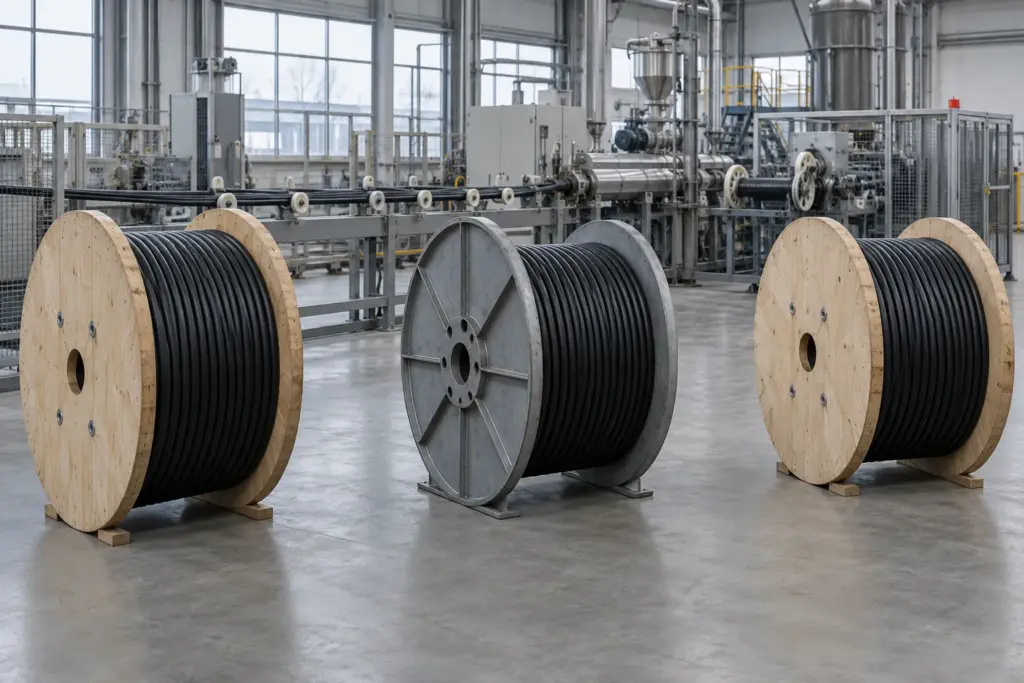
Cable production in 3D
From the wire rod on the pay-off to the finished drum: the machines stand in a serpentine line as on a shop floor, and the red arrows on the floor show the path of the wire. Point at a number or a machine and a bubble explains it.
Point the mouse at a number or a machine and a bubble explains it, no click needed. On a phone, tap the number. Drag to rotate the view.
All stations and parts
1. Pay-off
The wire rod runs off the coil or reel on the pay-off stand and is fed to the drawing machine.
- 1 : Input material of cable production: rolled wire of copper or aluminium, usually about 8 mm thick, supplied as a coil.
- 2 : Guides the wire off the coil and keeps it under even tension with a brake and guide pulleys.
2. Wire drawing
The drawing machine pulls the wire through ever smaller dies. It becomes thinner, longer and stronger.
- 3 : Tool with a very hard, funnel-shaped bore made of carbide or diamond. Each die reduces the wire diameter by one step – a classic wear part. Read more in the knowledge base: Drawing die
- 4 : Driven capstan that pulls the wire through the die. Its running surface is coated against wear, often with ceramic or carbide. Read more in the knowledge base: Drawing capstan
- 5 : Motor and gearbox drive the capstans at stepped speeds. Typical spare parts: bearings, couplings, gears.
3. Annealing
In the annealer the hard-drawn wire is heated by electric current and becomes soft and flexible again.
- 6 : Transfers the annealing current to the running wire. The running surface wears and is regularly reworked or replaced. Read more in the knowledge base: Contact pulley
- 7 : Carbon brushes conduct the current to the rotating contact pulley. Brushes and brush holders are typical wear parts of the annealer. Read more in the knowledge base: Carbon brush and holder
4. Stranding
The stranding machine twists several single wires into a strand, or several cores into an assembly.
- 8 : Carries the bobbins of the single wires and rotates around the machine axis. Includes bobbin bearings, brakes and drive. Read more in the knowledge base: Stranding cage with bobbins
- 9 : At the stranding point the wires come together. The die made of carbide or ceramic shapes and compacts the strand. Read more in the knowledge base: Closing die
- 10 : Eyelets, bushings and tubes made of ceramic guide the wires without damaging their surface. Read more in the knowledge base: Wire and thread guides
5. Extrusion
The extruder melts plastic granulate and applies it in the crosshead as insulation or sheath around the conductor.
- 11 : Here the melt meets the conductor passing through. Die and tip inside the head determine wall thickness and roundness. Read more in the knowledge base: Extrusion crosshead
- 12 : The screw conveys, compresses and melts the granulate in the heated barrel. Heater bands and temperature sensors keep the zones at temperature. Read more in the knowledge base: Extruder screw and barrel
- 13 : Feeds granulate and colour; often with a dryer and a conveying unit.
6. Cooling and testing
In the cooling trough the insulation solidifies in water. Gauges then check diameter and insulation.
- 14 : Water bath in several sections, partly with graded temperature. Includes pumps, nozzles and air wipes.
- 15 : Carry and guide the still soft cable through the water. Running surface and bearings must stay free-running.
- 16 : The spark tester applies high voltage and finds faults in the insulation. Other gauges measure diameter and wall thickness. Read more in the knowledge base: Spark tester and gauges
7. Take-up
The take-up lays the finished cable onto the drum, layer by layer.
- 17 : Carries the finished cable for storage and transport, made of wood or steel.
- 18 : Moves the cable back and forth during winding so that it lies neatly layer by layer. Rollers, spindle and bearings wear.
Requirements along cable production
Wire drawing
Drawing tools such as drawing dies, capstans and deflection pulleys with wear protection, bearings and drives of the drawing machine.
Annealing
Contact pulleys, carbon brushes and brush holders for transferring current to the wire.
Stranding and bunching
Wire guide pulleys, ceramic wire and thread guides, guide eyelets and closing dies.
Insulating and sheathing (extrusion)
Guide pulleys on pay-off and take-up, drives, heater bands and sensors of the extrusion line.
Screening and taping
Nickel and copper tape, PET-laminated copper foil, Al/PET and Al/PET/Al foils, polyester film, polypropylene foam tape, mica tape.
Take-up and packaging
Pulleys, bearings, brakes and drives for winders and reel handling.
Parts and input materials
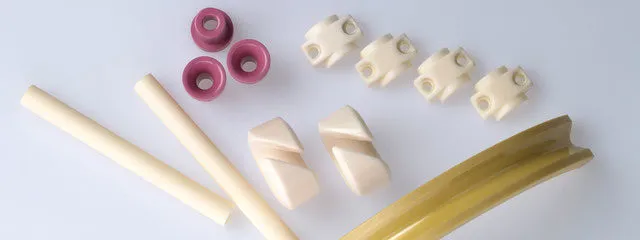
Ceramic parts
Ceramic bushings, guides and rods for points where the wire rubs.
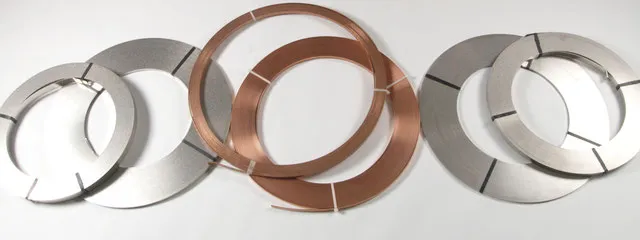
Tapes for screen and armour
Steel and copper tape wound into rings.
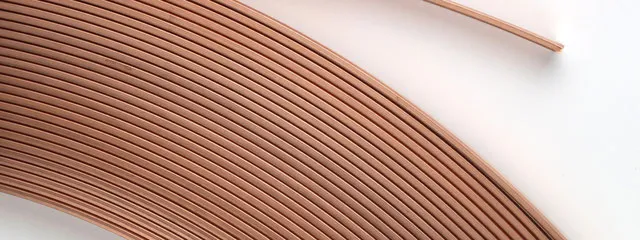
Copper tape
Thin copper tape for screening.

Flat copper wire
Flat wire as conductor material.
Pulleys and guides in detail
According to our previous website, deflection and wire guide pulleys are made of aluminium as standard and carry a wear protection layer based on ceramic or tungsten carbide in the groove. This keeps the pulley light while the running surface withstands the wire.
In addition there are plastic pressure and running rollers and ceramic parts for wire and thread guides.
Which details help
- For pulleys: diameter, groove profile, bore, material and required coating
- For drawing tools: wire material, inlet and outlet diameter, casing dimensions
- For input materials: material or layer structure, thickness, width, quantity and unit
- Drawing or photo of the existing part
Frequently asked questions
What is a drawing die?
A drawing die is a tool with a very hard, funnel-shaped bore. The wire is pulled through it and becomes thinner and longer. The core is usually made of tungsten carbide or diamond.
Why are wire guide pulleys coated?
The running wire wears into the groove. A ceramic or carbide layer extends service life and protects the wire surface.
Does Traydon also source cable machinery?
Our previous website names cable machines as part of industrial plant. Whether a specific machine can be sourced is clarified per request.
Related areas
Request items for the cable industry
With drawing, photo or material data.