
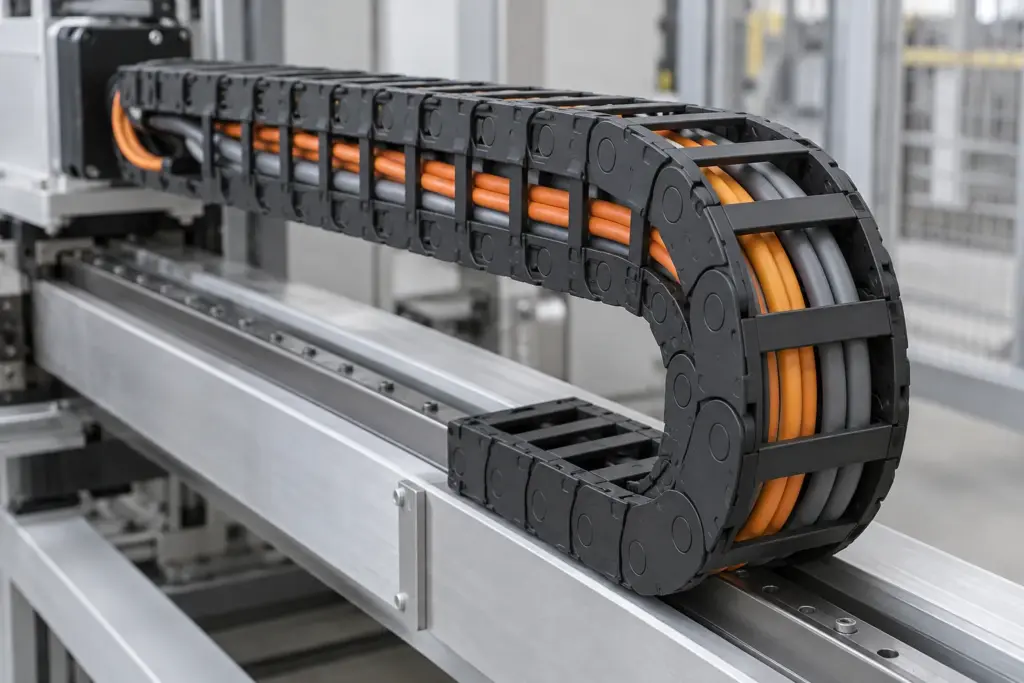
Cables in cable carriers are bent with every stroke, countless times over their service life. A normal cable breaks early. Continuous-flex cables are built exactly for this.
What makes a continuous-flex cable
Fine-stranded conductors, short lay lengths in stranding and a pressure-resistant sheath keep the cable from twisting in the chain and the cores from breaking. PUR sheaths are abrasion-resistant and oil-resistant, PVC is cheaper and suits simple applications.
Makers state a minimum bending radius as a multiple of the outer diameter. It must match the radius of the cable carrier. Further ratings are travel distance, speed and acceleration, number of cores and cross-sections, and a screen for motor and signal cables.
What a request for continuous-flex cables should contain
- number of cores, cross-section and screen
- bending radius of the cable carrier
- travel distance and speed
- environment: oil, coolant, temperature
- length per cable and number
Read more
Similar requirement?
Send us your parts list, a nameplate or a drawing. We check the sourcing and get back to you.